Join 70,00 Other Financial Professionals. Sign Up for Our Monthly Newsletter:

The Talent Crisis vs. The Millionaire Boom: How AI Will Decide Which Wealth Firms Survive

The wealth management industry is headed for a collision between unprecedented demand and a shrinking supply of advisors. This is not a looming crisis. It is the present reality, and artificial intelligence has emerged as the decisive technology that will separate industry winners from those that hemorrhage market share.

Why You Can’t Segment Your Prospects (And Why That Means You’re Treating Everyone the Same)

Every prospect is different—interests, timelines, and engagement levels all vary. Treating them the same because your CRM can’t segment effectively means missed opportunities. Consistent growth comes from communicating relevantly and responding to each prospect based on where they truly are in their journey.

The Oasis Group’s AI Readiness Index: First Maturity Benchmark for Wealth Management Industry

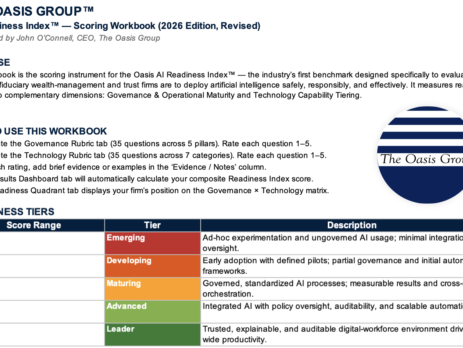
The Oasis AI Readiness Index™ is the industry’s first maturity benchmark built exclusively for fiduciary wealth management firms, trust firms, and family offices, utilizing a two-axis maturity model that measures both governance control and technology sophistication across 70 diagnostic questions.

Natural Language Research: Google Finance’s Deep Search Changes Investment Workflows

Traditional research workflow involves multiple database queries, manual data aggregation, and spreadsheet compilation before answering complex investment questions. Google Finance's Deep Search changes this by allowing portfolio managers to ask multi-factor questions in plain English and receive structured answers synthesizing information from multiple sources.

Your Wealth Management CRM Doesn’t Have Sales Stages – And It’s Costing You Clients

Your conversion process has stages whether your CRM acknowledges them or not. Prospects move from initial interest through discovery, evaluation, decision-making, and commitment. Managing this process without structured stages is like running a portfolio without knowing your asset allocation; you're missing the fundamental organizing principle that makes everything else make sense.